Hello chemists! Renu here. Chapter 3 of Class 9 Chemistry **Atoms and Molecules** sabhi science students ka base hai. Agar aapko is chapter mein chemical formula banana aa gaya, toh Class 10/11 ki equations aapke liye khel ban jayengi! Aaj hum chemical formulas likhne ka criss-cross valency method seekhenge.
Simple words mein, ek chemical formula kisi element ya compound ka molecular representation hota hai. Lekin Sodium, Calcium, ya Aluminium ke saath Chlorine kitne lagenge? Calcium Chloride $CaCl_2$ kyun hota hai, jagki Sodium Chloride sirf $NaCl$ hota hai? Iske piche Valency (combining capacity) ka role hai.
Step-by-Step Chemical Formula Writing
NCERT syllabus ke according chemical formulas likhne ke teen simple rules hain:
- Write the Symbols: Sabse pehle cation (metal/positive ion) ko left side likhein, aur anion (non-metal/negative ion) ko right side. (Jaise Calcium ka symbol $Ca$ aur Chloride ka $Cl$).
- Write the Valency: Dono symbols ke thik niche unki valency (ya charge) likhein. Calcium ka valence charge $2+$ hota hai aur Chlorine ka valence charge $1-$ hota hai.
- Criss-Cross: Dono ke charges ko diagonal arrow se cross-over kar dein. Calcium ko chloride ka charge ($1$) milega, aur Chlorine ko Calcium ka charge ($2$) milega. Resulting formula: $CaCl_2$!
⭐ Dalton's Atomic Theory Fact
John Dalton postulates state that atoms combine in simple whole-number ratios to form compounds. Hence, chemical formulas will always have integer subscripts (like $H_2O$ or $Al_2O_3$), never fractions like $H_{1.5}O$!
⚡ Exam Corner (Class 9)
Make sure to memorize polyatomic ions and their charges! Nitrate ($NO_3^-$) is $1-$, Carbonate ($CO_3^{2-}$) is $2-$, and Ammonium ($NH_4^+$) is $1+$. When writing formulas with polyatomic groups, always put them in brackets before adding subscripts (like $Ca(NO_3)_2$!).
Study Taught by Renu Dhaker
Watch the full lesson explained with clear board-work, visual animations, and step-by-step formulas on our YouTube portal: Watch Laws of chemical combination | Atoms and Molecule | chemistry | easy explained on YouTube .
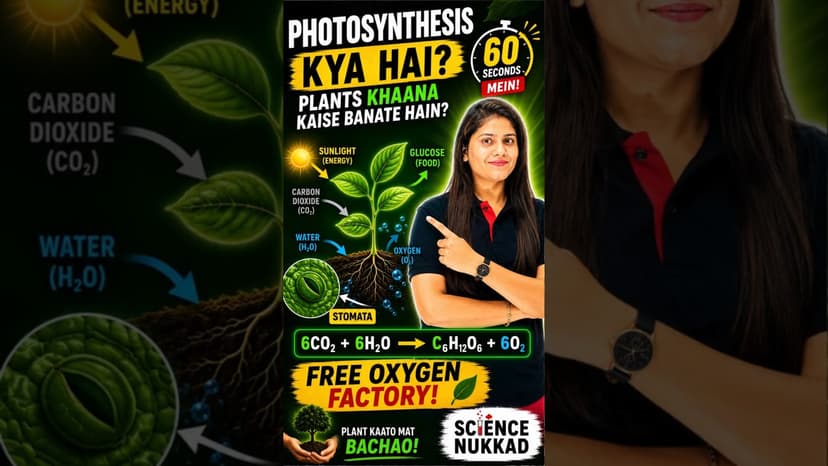
For a quick 60-second visual revision capsule of this exact topic, complete with custom quiz checkpoints, check out our related Short inside the Shorts Sandbox Hub!
To receive free daily NCERT guides, syllabus notifications, and micro learning cards, join our social handles:
- 📸 Instagram Profile: @renudhaker11 (Renu Dhaker)
- 👥 Facebook Community: @theknowledgenukkad Group
- 📺 YouTube Channel: Subscribe to The Knowledge Nukkad