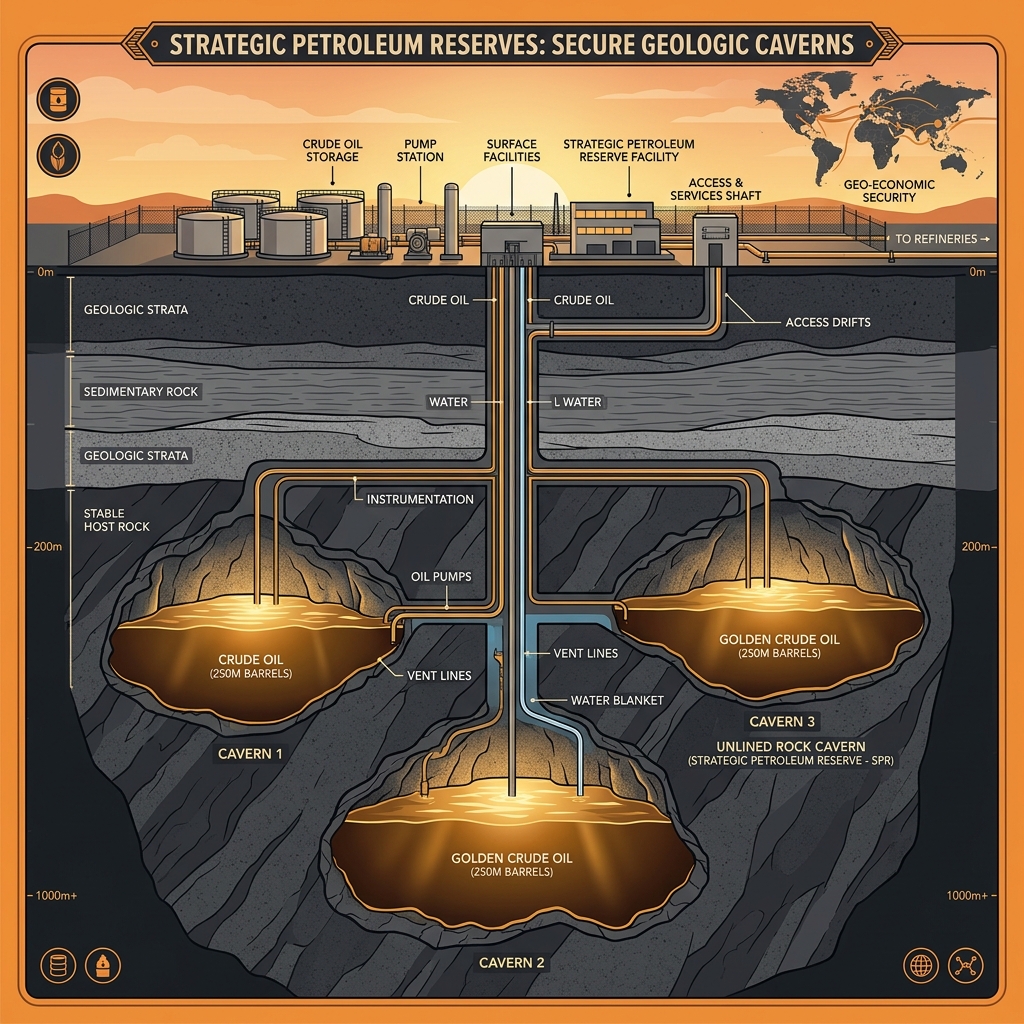
Energy security is vital for economic stability. For developing economies like India, which imports over 85% of its crude oil requirements, disruptions in global energy supply chains pose a major fiscal threat. To protect their economies from supply shocks caused by geopolitical conflicts, major oil-consuming nations build Strategic Petroleum Reserves (SPRs)—large underground emergency stockpiles designed to maintain domestic supply during crises.
Historical Context: The 1973 Oil Shock and the Birth of Emergency Stockpiles
The strategic use of petroleum reserves emerged following the 1973-1974 Yom Kippur War. In response to Western support for Israel, the Organization of Arab Petroleum Exporting Countries (OAPEC) declared an oil embargo, causing global oil prices to quadruple from $3 to nearly $12 per barrel, triggering high inflation in importing countries. In response, major consuming nations formed the International Energy Agency (IEA) in 1974. Under the IEA agreement, member states committed to maintaining emergency crude oil stocks equivalent to at least 90 days of net imports.
India's interest in strategic reserves grew after the 1990 Gulf War. The conflict caused oil prices to surge, and India's foreign exchange reserves fell to less than three weeks of import cover, nearly causing a default. To prevent future crises, the Indian government established the Indian Strategic Petroleum Reserves Limited (ISPRL) in 2004, constructing underground rock caverns to store emergency crude oil.
What is Right vs. What is Wrong
| What is Right (Strategic Best Practices) | What is Wrong (Structural Weaknesses) |
|---|---|
|
• Storing oil in underground unlined rock caverns, which are 90% cheaper to maintain than steel tanks and highly secure against sabotage. • Releasing reserves during verified supply shocks to prevent domestic price volatility. |
• Maintaining low storage capacities: India's strategic reserves (5.33 MMT) cover only 9.5 days, far below the IEA's 90-day benchmark. • Releasing strategic stockpiles during election cycles to artificially suppress retail prices rather than address real supply disruptions. |
| • Diversifying supplies and negotiating commercial storage agreements with friendly foreign National Oil Companies (like ADNOC). | • Facing delays in expanding Phase II storage due to land acquisition challenges and high capital costs. |
🛡️ Economic Safety Shield
Strategic reserves protect the broader economy. During supply crises, releasing oil prevents fuel shortages, helping maintain freight transport, stabilize food prices, and protect the national currency from sharp depreciation.
Geo-economics of Emergency Reserves
While India's dedicated strategic reserves provide only 9.5 days of cover, domestic oil marketing companies (OMCs) maintain another 64.5 days of commercial stock, bringing the total national storage cover to 74 days. Under Phase II, India plans to construct additional underground caverns at Chandikhol in Odisha (4 MMT) and Padur in Karnataka (2.5 MMT), which will add another 12 days of cover, bringing the nation closer to the IEA's 90-day security standard.
Table 3.1: International Strategic Petroleum Reserves Comparison
| Country | Strategic Storage Capacity | Days of Import Cover | Primary Storage Method | IEA Membership Status |
|---|---|---|---|---|
| United States | 714 Million Barrels (97 MMT) | 150+ Days | Underground Salt Caverns | Full Member |
| Japan | 520 Million Barrels (71 MMT) | 160 Days | Above-ground steel tanks | Full Member |
| China | 550 Million Barrels (75 MMT) | 90 Days | Steel tanks & caverns | Association Country |
| Germany | 180 Million Barrels (25 MMT) | 90 Days | Underground Salt Caverns | Full Member |
| India | 39 Million Barrels (5.33 MMT) | 9.5 Days (74 days with OMCs) | Underground Rock Caverns | Association Country |
Figure 3.1: Global Strategic Petroleum Reserves Capacities (Million Metric Tonnes - MMT)
Comparing absolute dedicated public oil stockpiles across major global energy consumers.